What Are the Top Ball Bearing Types for 2026?
Choosing the right ball bearing in 2026 requires more than comparing speed ratings or advertised service life. Real performance depends on load direction, operating temperature, contamination, lubrication, shaft fit, and maintenance access. A bearing that runs quietly in a laboratory may struggle beside dust, vibration, or repeated washdowns.
This introduction examines the leading types used across modern machinery. Deep-groove ball bearings remain versatile for radial loads and moderate axial loads. Angular-contact designs suit pumps, machine tools, and high-speed spindles requiring controlled axial support. Thrust ball bearings handle primarily axial forces, while self-aligning types help compensate for shaft or housing misalignment. Hybrid ceramic bearings may reduce friction and electrical damage in selected high-speed applications, but their cost needs careful justification.
The discussion will compare practical strengths, limitations, and suitable operating environments. It will also consider sealed and shielded designs, stainless steel options, precision classes, and emerging monitoring methods. ISO guidance, manufacturer data, and field experience should guide final decisions, rather than marketing claims alone. Numbers matter.
Still, selection is not perfectly predictable. Installation errors, poor lubrication, and unnoticed misalignment can shorten service life dramatically. This is where many buyers underestimate risk. A reliable choice balances calculated load capacity with maintenance habits, replacement availability, and the consequences of failure. The top ball bearing type is not universal; it is the one that matches the machine, duty cycle, and real working conditions.
Ball Bearing Basics and Their Role in Modern Machinery
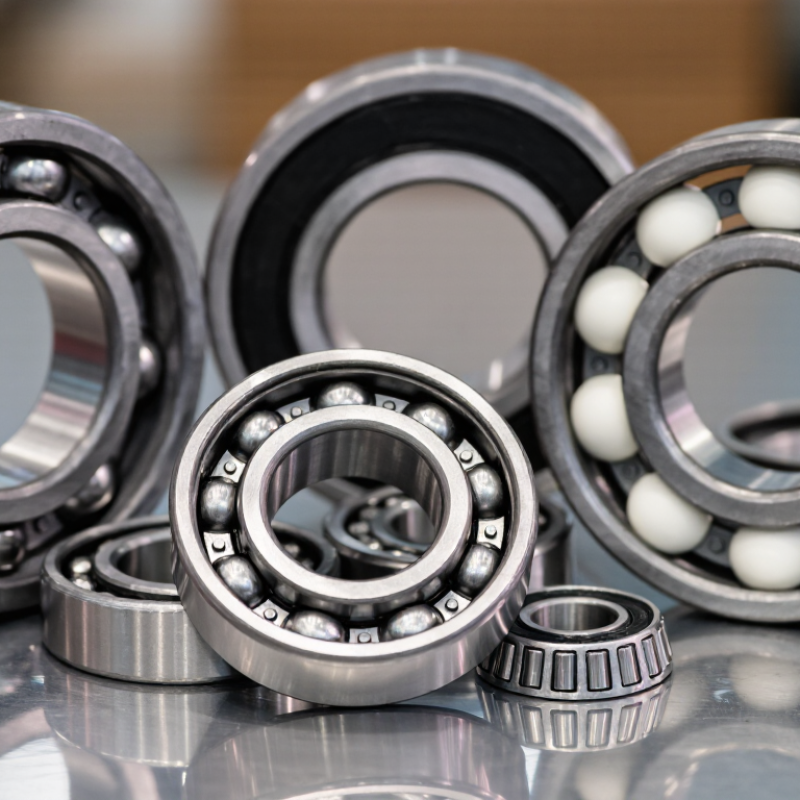
Ball bearings reduce friction between a rotating shaft and its housing. They use hardened balls, raceways, cages, seals, and lubrication. In a factory motor, this small assembly can support high speed while limiting heat and vibration. Deep-groove bearings remain common because they handle radial loads and moderate axial loads. They suit electric motors, pumps, fans, and conveyor rollers.
For 2026 machinery, the leading choices include deep-groove, angular-contact, thrust, self-aligning, and hybrid ceramic bearings. Angular-contact types manage combined loads in machine-tool spindles. Thrust bearings support axial force, such as screw mechanisms. Self-aligning designs tolerate shaft misalignment. A 2024 Grand View Research report estimated the global ball-bearing market at more than 18 billion U.S. dollars, with steady growth toward 2030. Its figures vary by scope, so forecasts should not be treated as precise facts.
Selection depends on speed, load, temperature, contamination, and maintenance access. ISO 281 provides methods for calculating bearing rating life, but real service life may be shorter. Poor lubrication often matters more than theoretical capacity. A dusty conveyor may need sealed bearings, while a precision spindle may require low-friction hybrid ceramic construction. I have found that installation errors are easily underestimated. A tight fit, a dirty tool, or excessive grease can raise operating temperature within minutes. The right bearing is not always the most advanced one.
What Are the Top Ball Bearing Types for 2026?
Ball bearings support rotating shafts by reducing friction between moving surfaces. The chart compares representative contact angles, a key design factor that influences whether a bearing is optimized for radial, combined, or axial loads.
Reading the chart: Deep-groove and self-aligning ball bearings are primarily suited to radial loads, angular-contact and four-point-contact bearings handle combined radial and axial loads, while thrust ball bearings are designed mainly for axial loads. Actual contact angles vary by bearing series and application.
How to Classify the Main Ball Bearing Types
What Are the Top Ball Bearing Types for 2026?
How to Classify the Main Ball Bearing Types
Ball bearings are best classified by load direction, contact angle, and internal design. Deep-groove ball bearings handle radial loads and moderate axial loads. They suit electric motors, conveyors, fans, and general machinery. Angular-contact bearings use a defined contact angle. They manage combined loads and support higher speeds when correctly preloaded. The greater the angle, the more axial load the bearing can usually carry.
Thrust ball bearings are designed mainly for axial loads. They are useful in screw mechanisms, turntables, and low-speed positioning systems. Self-aligning ball bearings tolerate small shaft or housing misalignments. This feature can prevent premature edge loading.
Single-row designs are simpler, while double-row designs carry more load but need more installation space. Hybrid ceramic bearings use ceramic balls with steel rings. They may reduce friction and electrical damage, but cost and application conditions still matter.
Tips:
Match the bearing to the real load path, not only the catalog speed. Check radial force, axial force, misalignment, temperature, sealing, and lubrication. A dusty workshop needs better protection than a clean test bench. Avoid excessive preload. It can create heat quickly. I have found classification charts useful, but they can oversimplify actual machines. Shaft fits, housing stiffness, and installation accuracy often change the result. If vibration rises after installation, inspect alignment and lubrication before blaming the bearing type. Mistakes happen. Recheck the assumptions.
Top Ball Bearing Types to Consider in 2026
Deep-groove ball bearings remain practical for electric motors, pumps, conveyors, and household equipment. They handle radial loads well and tolerate moderate axial loads. Angular-contact bearings suit machine tools, robotics, and high-speed spindles. Their contact angle improves axial-load control, but preload must be selected carefully. According to Grand View Research’s 2024 market assessment, the global ball-bearing market is expected to grow steadily through 2030, driven by automation, electric mobility, and industrial equipment upgrades.
Thrust ball bearings fit applications with mainly axial forces, such as screw mechanisms and rotating platforms. For combined loads, self-aligning ball bearings can reduce sensitivity to shaft or housing misalignment. Ceramic hybrid bearings may reduce friction and electrical damage in selected high-speed systems, although their cost requires evidence. No bearing wins everywhere. That assumption deserves testing. ISO 281 remains a useful reference for basic rating life, but real service life also depends on lubrication, contamination, mounting accuracy, and vibration.
Tips: Match the bearing to load direction, speed, temperature, and available space. Check shaft fits with measured dimensions, not guesses. Keep lubricant quantity controlled; excess grease can raise operating temperature. Review failure photos and maintenance records before changing type. A cheaper bearing may become expensive when sealing, downtime, and installation errors are included.
How to Choose the Right Ball Bearing for Each Application
What Are the Top Ball Bearing Types for 2026?
Choosing a ball bearing starts with the application, not the catalog label. Grand View Research valued the global ball bearing market at about USD 20 billion in 2023. Its report expects continued growth through 2030, driven by automation, vehicles, and industrial equipment. That expansion creates more choices, but not always better decisions.
Deep-groove bearings suit electric motors, conveyors, and household equipment. They handle radial loads well and tolerate moderate axial loads. Angular-contact bearings are better for machine-tool spindles, pumps, and precision assemblies. Their contact angle supports combined loads and higher speeds. For vertical shafts or screw mechanisms, thrust ball bearings manage axial force more effectively. They are poor choices for heavy radial loads.
Check the load direction first. Then measure speed, temperature, contamination, available space, and required life. A sealed bearing may reduce maintenance near dust, while an open bearing can support relubrication in controlled equipment. Ceramic hybrid designs may reduce friction at high speed, but their cost needs justification. Mordor Intelligence reports steady bearing-market growth, yet market forecasts vary by definition and region. Treat forecasts as guidance, not proof.
In field work, misalignment often causes more damage than bearing selection. A clean shaft, correct fit, and precise installation matter greatly. I have seen a technically suitable bearing fail early because mounting force passed through the rolling elements. That detail is easy to overlook. Load calculations should follow ISO 281, while actual temperature and vibration readings should challenge the original assumptions.
What Are the Top Ball Bearing Types for 2026? — How to Choose the Right Ball Bearing for Each Application
| Ball Bearing Type | Primary Load Capability | Typical Speed Capability | Best-Suited Applications | Main Advantages | Key Limitations | Common Material Options | Selection Priority |
|---|---|---|---|---|---|---|---|
| Deep-Groove Ball Bearing | Handles radial loads and moderate axial loads in both directions. | High; commonly selected for general-purpose high-speed operation. | Electric motors, pumps, fans, conveyors, gearboxes, household equipment, and general machinery. | Simple design, low friction, relatively low cost, wide size availability, and easy installation. | Less suitable for heavy combined loads, substantial shaft misalignment, or high axial loads. | Through-hardened bearing steel; stainless steel for corrosion resistance; hybrid ceramic for reduced friction and electrical insulation. | Excellent general choice |
| Angular-Contact Ball Bearing | Supports radial loads and high axial loads in one direction; paired arrangements support axial loads in both directions. | High to very high, depending on contact angle, preload, lubrication, and cage design. | Machine-tool spindles, pumps, compressors, robotics, precision gearboxes, and high-speed rotating assemblies. | High axial-load capacity, good rigidity, accurate positioning, and suitability for preload arrangements. | Requires correct orientation and preload; sensitive to mounting errors and excessive heat. | Bearing steel; ceramic balls with steel rings for high-speed or electrically demanding applications. | Excellent for precision and axial loads |
| Thrust Ball Bearing | Designed primarily for axial loads; one-direction or two-direction designs are available. | Low to moderate compared with radial ball-bearing designs. | Vertical shafts, turntables, low-speed indexing equipment, screw mechanisms, and light axial-load systems. | Efficient axial-load support, compact axial arrangement, and straightforward installation. | Cannot accommodate significant radial loads; unsuitable for shaft misalignment and many high-speed applications. | Through-hardened bearing steel; stainless steel for corrosive environments. | Use for primarily axial loads |
| Self-Aligning Ball Bearing | Handles radial loads and limited axial loads while compensating for shaft or housing misalignment. | Moderate to high, generally below an equivalent deep-groove design under ideal alignment. | Long shafts, agricultural equipment, textile machinery, conveyors, fans, and applications with flexible housings. | Compensates for angular misalignment and reduces the risk of edge loading caused by installation or deflection. | Lower load capacity than some fixed-alignment designs; limited axial capacity and reduced rigidity. | Bearing steel; sealed versions may use synthetic rubber seals and standard industrial lubricants. | Best for alignment uncertainty |
| Four-Point-Contact Ball Bearing | Supports combined radial and axial loads, with axial loads possible in both directions from a single bearing. | Moderate; usually lower than comparable deep-groove or angular-contact bearings. | Robotic joints, slewing mechanisms, indexing tables, aerospace actuators, and compact axial-location systems. | High axial capacity for its cross-section, compact arrangement, and reduced bearing count in some designs. | Requires careful load analysis; unsuitable for continuous high-speed operation under heavy moment loads unless specifically designed for it. | Through-hardened bearing steel; corrosion-resistant steel for specialized environments. | Best for compact combined loading |
| Miniature and Instrument Ball Bearing | Light radial loads and limited axial loads. | Very high relative to size when properly lubricated and balanced. | Medical instruments, small motors, encoders, laboratory equipment, miniature pumps, and precision mechanisms. | Very small envelope, low starting torque, and good rotational sensitivity. | Low load and shock capacity; vulnerable to contamination, excessive preload, and improper handling. | Stainless steel; chrome-bearing steel; ceramic balls for selected high-speed or low-friction designs. | Best for compact precision systems |
| Hybrid Ceramic Ball Bearing | Radial and moderate axial loads, depending on the internal design. | Very high potential speed with suitable lubrication, preload, and heat management. | High-speed spindles, electric motors, generators, vacuum equipment, robotics, and electrically sensitive machinery. | Lower ball density, reduced centrifugal forces, good wear resistance, low friction, and electrical insulation through the ceramic rolling elements. | Higher purchase cost; ceramic balls are hard but brittle, and incorrect preload or contamination can cause premature damage. | Steel rings with silicon-nitride balls; specialized seals and high-speed lubricants as required. | Best for speed and electrical isolation |
| Stainless-Steel Ball Bearing | Radial and limited-to-moderate axial loads, depending on the bearing geometry. | Moderate to high; often lower than equivalent standard steel bearings of the same size. | Food-processing equipment, laboratory devices, marine equipment, medical machinery, and damp or lightly corrosive environments. | Improved corrosion resistance, clean appearance, and suitability for frequent washdown when paired with suitable seals and lubricant. | Lower hardness and load ratings may apply compared with standard bearing steel; not automatically suitable for severe chemical exposure. | Corrosion-resistant bearing steel; polymer seals; food-grade or specialty lubricants where required. | Best for moisture and cleanliness |
| Flanged Ball Bearing | Primarily radial loads with limited axial-load capability, depending on the flange and bearing design. | Moderate to high. | Small motors, printed-circuit-board equipment, linear mechanisms, compact housings, and applications requiring axial positioning. | Flange simplifies axial location and housing installation, especially in compact assemblies. | Flange is not intended to replace a high-capacity thrust bearing; housing and flange loads must be checked carefully. | Chrome-bearing steel, stainless steel, and polymer cages or seals for specialized conditions. | Best for simplified mounting |
| Sealed Ball Bearing | Load capability is based on the internal bearing type; seals mainly protect the raceway and retain lubricant. | Moderate to high, depending on seal friction, lubricant, clearance, and operating temperature. | Electric motors, gearboxes, conveyors, appliances, fans, and equipment where relubrication is difficult. | Reduced maintenance, protection from ordinary dust and moisture, and factory-applied grease. | Seal friction generates heat; seals have temperature, chemical, and speed limits and are not a substitute for proper environmental protection. | Bearing steel with nitrile, fluoroelastomer, metal, or low-friction polymer sealing elements. | Best for low-maintenance operation |
Selection note: Final bearing selection should consider the calculated radial and axial loads, required life, speed, operating temperature, lubrication, contamination, shaft and housing fits, misalignment, noise, sealing, and available installation space.
Key Innovations Shaping Ball Bearings in 2026
Ball bearing selection in 2026 depends on load, speed, temperature, and maintenance access. Deep-groove bearings remain practical for motors, pumps, and conveyor systems. Angular-contact types support combined radial and axial loads, making them suitable for machine-tool spindles. Thrust ball bearings handle axial forces, but they require careful alignment. Self-aligning designs can tolerate shaft deflection, although their extra movement may reduce precision.
The strongest innovation is embedded condition monitoring. Miniature sensors can track vibration, temperature, and rotational behavior near the bearing raceway. Engineers can use this data to identify lubrication loss before surface damage spreads. Wireless monitoring is also becoming more practical in remote equipment. However, sensor accuracy still depends on installation quality and signal stability. That detail is easy to overlook.
Hybrid ceramic bearings offer lower friction and electrical insulation in selected high-speed applications. Improved seal designs help retain lubricant while blocking fine dust and moisture. New surface treatments may reduce wear during frequent start-stop cycles. These improvements are useful, not magical. Real performance still depends on correct preload, housing tolerances, and lubricant choice.
Manufacturers are also testing lighter cages and more precise production methods. Digital simulations can predict contact stress before physical testing begins. Field trials remain essential. A bearing that performs well in a laboratory may behave differently beside heat, dirt, and vibration. Engineers should compare measured service data with published ratings before approving a 2026 design.
Related Posts
-
Understanding the Basics of Ball Bearing Selection for Optimal Performance
-
How to Choose the Right Ball Bearing Rollers for Your Application Needs
-
Exploring the Future of Ball Bearing Rollers Industry at the 2025 China Import and Export Fair
-
How to Choose the Right Small Ball Bearings for Your Project
-
Top 10 Benefits of Using Stainless Steel Ball Bearings for Your Projects
-
2026 How to Choose Stainless Steel Ball Bearings for Your Needs?