

' d='M0 0h21v15H0z'/%3E%3Cpath fill='url(%23b)' d='M0 0h21v5H0z'/%3E%3Cpath fill='url(%23c)' d='M0 5h21v5H0z'/%3E%3Cpath fill='url(%23d)' d='M0 10h21v5H0z'/%3E%3C/g%3E%3C/svg%3E)
What Are the Top Ball Transfer Unit Types in 2026?
A crate glides across a workbench with only a light push. Beneath it, small steel balls carry the load and change its direction. That simple movement is the purpose of a ball transfer unit. Yet choosing one is not always simple. Mounting style, load capacity, surface material, and operating conditions can change which design performs well.
This guide examines the main ball transfer unit types buyers may compare in 2026. These include flange-mounted, stud-mounted, spring-loaded, heavy-duty, and inverted units, along with models made for particular environments. Each type has practical trade-offs. A compact unit may fit a tight conveyor layout, while a larger housing may better support concentrated loads. Stainless steel can suit damp or washdown areas, but material alone does not guarantee long service life. Sealing, maintenance, and the supported surface matter too.
There is no universal “top” unit for every application. The right choice depends on the load, transfer direction, installation space, and expected use. Product specifications should be checked against the actual working conditions, not just a headline capacity. The categories are not always neat, either; manufacturers may describe similar designs differently. That distinction is easy to miss. The sections ahead explain what sets each type apart and which details deserve closer review before selection.
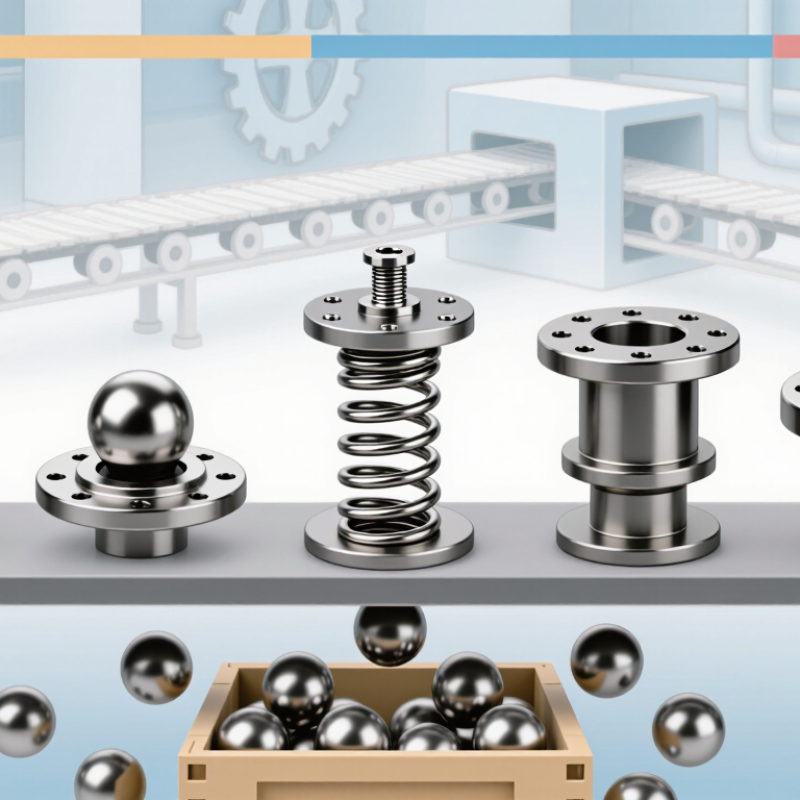
What Is a Ball Transfer Unit and How Does It Work?
A ball transfer unit is a compact conveyor component that lets a load move in several directions. A large exposed ball sits in a housing and rolls over smaller supporting balls inside. As a crate or sheet passes across it, the main ball turns with the load, reducing sliding friction. Unlike a powered roller, the unit does not drive the load. It simply supports movement. Common types include flange-mounted, threaded-stem, spring-loaded, and heavy-duty units.
Selection depends on load weight, ball spacing, surface condition, and exposure to dust or moisture. MHI’s 2024 Annual Industry Report, based on a survey of supply-chain professionals, found that 55% planned to increase technology investment. That broad trend reflects growing interest in material-handling improvements, but it is not a performance measure for ball transfer units. Real-world results still depend on installation and maintenance. A dusty shop floor can change the equation.
Tips: Test the unit with the actual load. Check that its base sits level and that several units share the weight. Keep grit out of the housing; one stuck ball can make a smooth transfer feel rough.
| Type or Configuration | How It Works | Typical Applications | Key Selection Considerations |
|---|---|---|---|
| Flange-Mounted Ball Transfer Unit | A housing with a mounting flange is fastened to a plate, frame, or conveyor surface. The exposed main ball supports and moves the load in multiple directions. | Assembly tables, material-handling stations, transfer decks, and machine fixtures. | Check the mounting pattern, available clearance, load distribution, and whether the fasteners and supporting surface can carry the intended load. |
| Threaded Ball Transfer Unit | A threaded stem screws into a tapped hole or a compatible mounting component, allowing the unit to be installed or adjusted from its stem. | Workstations, equipment fixtures, and installations where a compact, removable mounting point is useful. | Match the thread and engagement depth to the mounting part. Confirm that the stem is adequately supported and secured against loosening. |
| Stud-Mounted Ball Transfer Unit | A projecting stud locates the unit in a hole or mounting feature. Depending on the design, a nut or other retainer secures it in place. | Custom fixtures, guided handling equipment, and applications that use a locating hole in a plate or frame. | Verify the stud dimensions, retention method, hole fit, and resistance to movement under operating loads. |
| Spring-Loaded Ball Transfer Unit | A spring-supported housing lets the main ball move vertically as the load passes over it. This can help maintain contact when load heights vary. | Transfer surfaces with uneven loads, transitions between work areas, and applications that need limited vertical compliance. | Consider spring travel, preload, operating load, and the risk of excessive deflection. Spring action does not replace correct load support. |
| Heavy-Duty Ball Transfer Unit | A robust housing and load-support arrangement carry higher loads than a light-duty unit of comparable size. The exact capacity depends on the unit design and installation. | Industrial handling tables, heavy workpieces, and transfer systems for substantial loads. | Use the manufacturer's rated capacity for the actual mounting orientation and service conditions. Account for impact, uneven load sharing, and contamination. |
| Miniature Ball Transfer Unit | A compact housing and small main ball provide multi-directional movement where installation space is limited. | Small fixtures, compact mechanisms, light-duty handling surfaces, and precision equipment. | Check the allowable load, ball size, mounting space, and sensitivity to dust or debris; small units are not automatically suitable for precision positioning. |
| Sealed or Contamination-Resistant Unit | Protective features help limit the entry of dust or debris into the internal bearing area. Protection varies by construction and is not necessarily a complete seal. | Environments where airborne particles or process debris could interfere with free ball movement. | Confirm the specified protection level, cleaning requirements, material compatibility, and suitability for the particular environment. |
| Stainless-Steel Ball Transfer Unit | Selected components are made from stainless steel to support corrosion resistance in suitable environments. Corrosion performance depends on the alloy, finish, and exposure. | Washdown areas, damp settings, and applications where corrosion resistance is a design requirement. | Check which components are stainless steel and confirm that the grade and cleaning regime suit the chemicals, moisture, and operating conditions. |
| How a Ball Transfer Unit Works | A large load-bearing ball rests on smaller supporting balls inside a housing. The supporting balls let the main ball rotate in different directions, allowing a supported object to move across a surface. | Changing direction, repositioning, or transferring loads across a work surface without relying on a single fixed travel direction. | Choose units for the load, spacing, mounting orientation, surface conditions, and required movement. Keep the contact surface clean and distribute the load across enough units. |
Related Posts
-
2026 Best Ball Transfer Units for Global Buyers?
-
How to Choose the Right Sealed Bearings for Your Industrial Applications
-
2026 Top Stainless Steel Bearings What You Need to Know?
-
What is a ball bearing puller and how does it work?
-
Understanding the Unique Advantages of Flanged Bearings for Global Procurement
-
China Best Angular Contact Ball Bearing Supplier?