Best Flanged Bearings Manufacturers and Suppliers in China

Choosing reliable flanged bearings manufacturers and suppliers in China requires more than comparing catalog prices. These components guide rotating shafts in motors, conveyors, medical equipment, packaging lines, and small appliances. Their flanges help simplify positioning and reduce unwanted axial movement during assembly. However, performance depends on fit, load direction, lubrication, sealing, material, and operating temperature. A polished product page cannot prove consistent production. Field evidence matters.

This guide examines Chinese suppliers through practical purchasing criteria. It considers manufacturing experience, machining capability, heat treatment, quality control, and export communication. Useful evidence may include ISO 9001 certification, inspection records, material traceability, and application references. Samples should be checked for dimensions, noise, rotation smoothness, and flange accuracy before bulk orders. Ask about clearance classes, seal types, grease options, packaging, and replacement support. Small details matter.

The strongest manufacturers usually explain tolerances clearly and respond with engineering data. They should also acknowledge limits instead of promising universal suitability. A supplier serving high-speed machinery may not fit a dusty, shock-loaded application. That difference is easy to overlook. Buyers should compare total value, including rejection risk, delivery stability, documentation, and technical assistance. Independent testing remains sensible for critical equipment. This review does not treat every listed company as equally capable. Capabilities change, and public information can be incomplete. Use these findings as a focused starting point for verification, quotation, and responsible supplier selection.
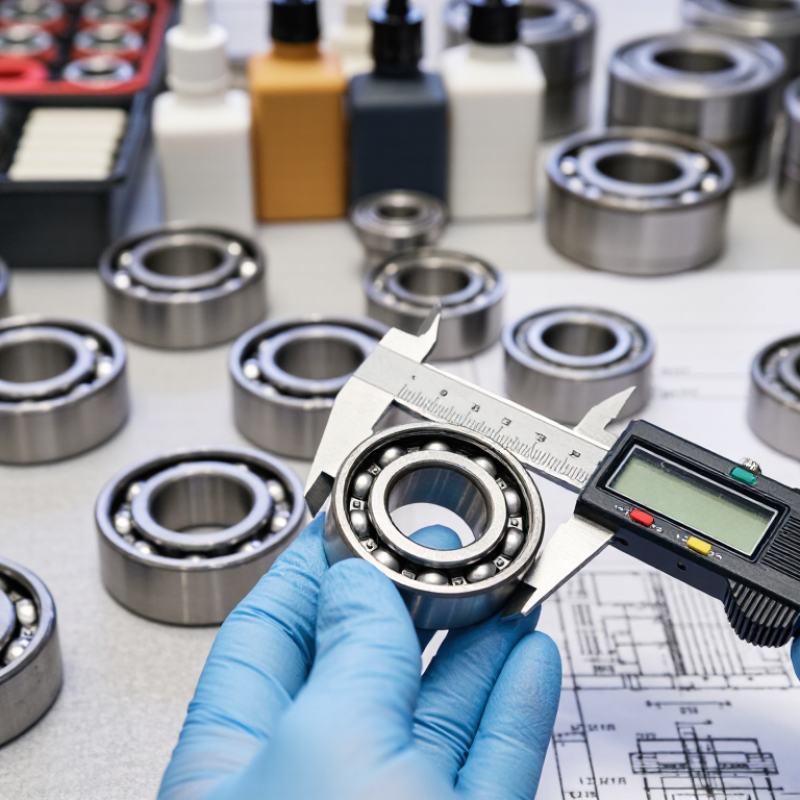
Best Flanged Bearings Manufacturers and Suppliers in China

What Are Flanged Bearings and How Do They Work?

What Are Flanged Bearings and How Do They Work?

A flanged bearing combines a rolling bearing with a projecting rim on its outer ring. The flange helps locate the bearing against a housing shoulder, limiting axial movement during operation. This can simplify assembly in compact equipment, such as conveyor rollers, packaging machines, and small gearboxes. Inside, balls or rollers travel between raceways, reducing friction as a shaft turns. The flange locates the unit; it does not replace a properly designed housing or secure mounting.

Bearing life depends on load, speed, lubrication, contamination, and installation. ISO 281 defines the basic rating life for rolling bearings:

For a ball bearing, L10 = (C/P)³ million revolutions, where C is the basic dynamic load rating and P is the equivalent dynamic load.

L10 represents the life that 90% of a sufficiently large group of identical bearings is expected to reach under stated conditions. It is a statistical estimate, not a guarantee. Real installations can fall short, sometimes because a small alignment error goes unnoticed.

Tips: Check shaft fit, housing bore, and flange contact before installation. Keep grease clean, and avoid striking the bearing directly during fitting. A useful detail to reconsider: a larger flange does not automatically mean greater load capacity. Compare bearing ratings and operating conditions, not appearance alone.

Key Types and Applications of Flanged Bearings

Flanged bearings combine a bearing insert with a mounted housing, making them useful where shafts need support close to a machine wall or frame. Common designs include two-bolt oval units, three-bolt round units, and four-bolt square units. The bolt pattern affects mounting stability and available space, so check the equipment layout before selecting a style.

Housing material matters, too. Cast-iron housings are often used for sturdier industrial equipment, while stainless-steel or polymer options may suit damp or washdown areas. These choices are not interchangeable in every setting. Flanged bearings appear in conveyor rollers, packaging lines, agricultural machinery, and ventilation systems. For example, a conveyor bearing may face dust and vibration, while a fan bearing may need to handle continuous rotation and heat. Load, speed, shaft size, sealing, and alignment all influence service life. A bearing can look right on paper and still fail early if the shaft is misaligned.

Tips: Measure the shaft and bolt spacing, then confirm the load and operating environment. Check seals and lubrication intervals during maintenance. Small details matter. In wet or dusty locations, inspect for contamination more often; the ideal interval depends on actual conditions.

How to Evaluate Chinese Flanged Bearing Manufacturers

When evaluating Chinese flanged bearing manufacturers, look beyond catalog prices. Grand View Research estimated the global bearing market at USD 118.8 billion in 2023, underscoring the scale and variety of suppliers. Market size alone does not prove quality. Ask for material certificates, inspection records, and traceable batch numbers. A stamped flange should sit flat against a test plate, with no visible burrs around its bolt holes. Small details matter.

Request dimensional inspection results against ISO 492 tolerances, and ask how the factory controls fit and runout. For load-life comparisons, ISO 281 provides a standardized rating-life method; it is not a guarantee of service life in your application. Ask suppliers to state assumptions, including load, speed, lubrication, and operating temperature. Then compare like with like. If a quotation promises unusually long life but omits those conditions, treat the figure cautiously.

A useful audit includes a sample order, not just a video call. Measure the bore and flange thickness on arrival, check rotation by hand, and record noise or roughness. Ask how rejected parts are contained and how corrective actions are verified. Request references from buyers with similar duty cycles, while protecting confidential information. I would still want to inspect production records in person; polished documents can miss shop-floor variation.

Leading Manufacturing Regions and Supplier Capabilities in China

China’s flanged-bearing supply base is spread across several industrial regions, not one single-purpose hub. Zhejiang and Jiangsu have wide machinery and component networks, supporting access to turning, grinding, seals, and packaging. Shandong and Hebei also have metalworking suppliers, including firms with casting, forging, and heavier machining capabilities. Regional strengths vary by city and factory, so a location alone cannot confirm a supplier’s expertise. Details matter.

When comparing suppliers, examine their production processes and inspection routines.

Ask whether they machine the flange and bearing seat in-house, and how they check dimensions, runout, and surface finish. Sample reports, material records, and clear tolerances can help clarify what a factory actually controls. Some suppliers can adapt bore sizes, mounting patterns, or seals, but custom work may affect lead times and minimum quantities.

A polished catalogue can still hide uneven batch consistency, an issue that is easy to miss during initial sampling. Ask for evidence. Visiting a workshop or reviewing recent inspection records can reveal gaps between listed capabilities and routine production.

Quality Standards, Pricing, and Export Considerations

For buyers comparing flanged bearing manufacturers and suppliers in China, quality checks should go beyond a certificate on the wall. ISO 492:2014 defines dimensional and running-accuracy tolerances for rolling bearings; request the stated tolerance class and inspection records for the exact model. Check bore diameter, flange-face runout, seal type, lubricant, and noise results. Ask for a sample report linked to the production lot. Small details matter. A polished sample may not represent every batch, so confirm how the supplier controls repeat production. ISO 9001 certification indicates a quality-management system, not a guarantee that each bearing meets your application’s load or service-life needs.

Pricing depends on steel grade, heat treatment, sealing, order volume, inspection scope, and packaging. Compare quotations on the same drawing and delivery terms, then separate tooling, testing, and freight charges. A low unit price can become costly if tolerances or packaging are unclear. For exports, confirm carton labeling, moisture protection, shipping documents, lead time, and responsibility for transport and insurance. The World Bank’s 2023 Logistics Performance Index ranked China 19th among 139 economies; this offers broad logistics context, not a shipment-level delivery promise. Request recent dispatch records and agree on a realistic buffer. It is easy to underestimate port delays. Ask, too, how claims and replacement parts will be handled after arrival.

Best Flanged Bearings Manufacturers and Suppliers in China - Quality Standards, Pricing, and Export Considerations
Supplier / Product Category Typical Product and Materials Relevant Quality Checks Indicative Unit Price (USD) Typical MOQ and Lead Time Export Considerations
Standard cast-iron flange-unit supplier Two- or four-bolt housing with a self-aligning insert; common configurations include UCFL and UCF. Housing is typically cast iron; inserts commonly use bearing steel. Verify insert dimensions, housing bolt pattern, sealing arrangement, radial internal clearance, and material documentation. ISO 492 covers dimensional and running accuracy classes for rolling bearings; confirm which requirements apply to the quoted product. Approximately $2–$15 per unit for common sizes in bulk orders; size, insert design, and order quantity affect price. Often available from stock in standard sizes; made-to-order minimums and lead times vary. Obtain a written MOQ and delivery schedule. Specify the complete designation, shaft diameter, housing material, lubrication, and packaging. Confirm carton and pallet dimensions for freight quotations.
Stainless-steel flange-unit supplier Flanged units using stainless-steel inserts and, depending on the design, stainless or polymer housings; commonly selected for washdown or corrosive environments. Check the stated stainless-steel grades for each component, corrosion-resistance claims, seal material, lubricant suitability, and traceability. Do not assume all components are stainless because the unit is described as stainless. Approximately $8–$40 per unit in bulk quantities; specification, grade, and size are major cost factors. Stock availability is more limited than for standard cast-iron units; confirm production time and whether samples are available. Request material declarations and corrosion-test details where required. Check destination-country requirements for food-contact or hygienic applications separately.
Thermoplastic-housing flange-unit supplier Polymer flange housing paired with a bearing insert; used where low weight and resistance to certain chemicals are useful. Temperature and load limits depend on the specific design. Verify polymer type, operating-temperature range, load ratings, chemical compatibility, insert fit, and dimensional drawings. Confirm that stated ratings apply to the assembled unit. Approximately $3–$20 per unit in bulk quantities, depending on size, polymer, and insert specification. Standard sizes may be stocked; customized housing colors or designs can require higher minimum quantities and additional lead time. Confirm packaging protects housings from crushing during transport. Request the product drawing and installation guidance before ordering.
Precision-focused bearing-unit supplier Selected flange units with tighter specified dimensional or running accuracy, controlled fits, or application-specific sealing and lubrication. Ask for inspection records, acceptance criteria, dimensional reports, and batch traceability. ISO 9001 refers to a quality-management-system standard; certification should be verified for the supplying legal entity and site. Approximately $10–$60 or more per unit; tighter tolerances and special configurations can raise costs substantially. Usually quotation-based; engineering review, sample approval, and production testing may extend lead time. Agree on inspection methods, sampling plan, documentation, and responsibility for nonconforming goods before placing the order.
Custom or OEM flange-unit supplier Configured units with customer-specified dimensions, materials, seals, lubrication, surface treatment, or packaging; suitability depends on engineering validation. Approve drawings and a pre-production sample; define critical dimensions, material requirements, performance tests, and change-control procedures. Quotation-based; tooling, testing, and customization costs may apply in addition to the unit price. MOQ is negotiated and may be higher than for standard products. Lead time depends on design approval, tooling, and component availability. Set ownership and approval rules for drawings and tooling. Confirm export packing, marks, documents, and delivery terms in the purchase contract.
Pricing and sourcing note: Price ranges are indicative budgeting estimates, not supplier quotations. Actual prices vary with bearing size, materials, order quantity, inspection requirements, packaging, freight, and Incoterms. Before purchase, request a dated quotation, product drawings, applicable test records, country of origin, HS-code confirmation, and export-document requirements. ISO 281 addresses rolling-bearing dynamic load ratings and rating life; it is not a blanket certification of a complete flange unit.