

' d='M0 0h21v15H0z'/%3E%3Cpath fill='url(%23b)' d='M0 0h21v5H0z'/%3E%3Cpath fill='url(%23c)' d='M0 5h21v5H0z'/%3E%3Cpath fill='url(%23d)' d='M0 10h21v5H0z'/%3E%3C/g%3E%3C/svg%3E)
What Is a Ball Bearing and How Does It Work?
What Is a Ball Bearing and How Does It Work?
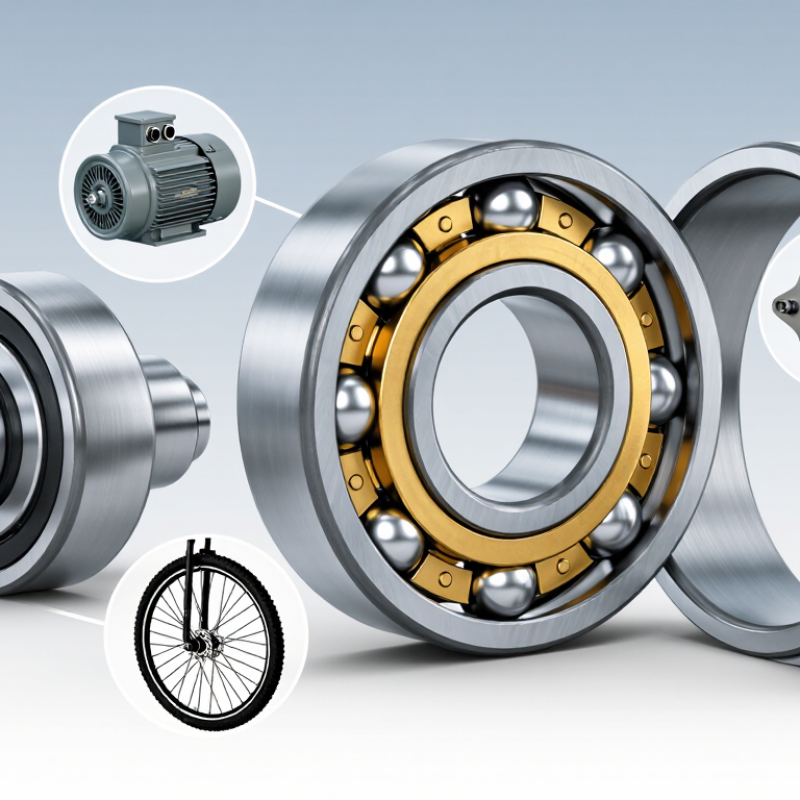
A ball bearing is a mechanical component that supports rotating or moving parts. It uses hardened steel or ceramic balls between two circular rings. These rings are called the inner race and outer race. A cage keeps each ball evenly spaced. This small structure appears in electric motors, bicycles, pumps, conveyors, and vehicle wheels.
SKF founder Sven Wingquist is widely recognized for advancing self-aligning ball bearing technology. His practical engineering principle can be stated simply: “A bearing must carry load while allowing smooth movement.” That idea remains relevant today. The balls roll across polished raceways instead of sliding directly against them. Rolling reduces friction, heat, and energy loss. However, it does not remove friction completely.
When a shaft turns, the inner race usually rotates with it. The balls transfer the load toward the stationary outer race. Seals or shields help protect the internal lubricant from dust and moisture. A dry or contaminated bearing may produce a rough hum, excessive heat, or visible vibration. Installation also matters. A slight misalignment can shorten service life.
Load direction changes bearing performance. Radial loads press toward the shaft’s center. Axial loads act along the shaft. Some bearings handle both, but not equally well. Engineers therefore consider speed, temperature, lubrication, clearance, and expected service hours.
The explanation is useful, but incomplete without real operating conditions. A catalog rating cannot predict every failure. Poor mounting, corrosion, or over-tightening can defeat excellent design. Understanding these limitations makes ball bearing selection more reliable.
Ball Bearing: Definition, Purpose, and Basic Structure
A ball bearing is a machine element that reduces friction between moving parts. It usually contains an inner ring, outer ring, balls, and a cage. The inner ring fits around a rotating shaft. The outer ring sits inside a housing. Hardened balls travel between both rings, carrying radial or axial loads while rolling smoothly.
Its purpose is practical: less sliding contact, lower heat, and more stable rotation. ISO 281 explains bearing life through fatigue-based rating calculations, not simple calendar time. Load, speed, lubrication, contamination, and alignment all matter. The U.S. Department of Energy reports that motor-driven systems use about 69% of industrial electricity in the United States. Small efficiency losses can therefore become costly across many machines. In field maintenance, unusual noise or rising temperature often appears before complete failure. Still, diagnosis is not always obvious.
Tips: Keep lubricant clean and correctly measured. Avoid forcing a bearing onto the wrong ring. Check shaft alignment with suitable instruments. A bearing may look clean but still contain damaging particles. This is easy to miss. Record temperature, vibration, and operating hours during inspections. These simple records support better decisions, although they cannot replace engineering judgment. When selecting a bearing, compare the load direction, required speed, sealing conditions, and calculated rating life. Generic replacement is sometimes a poor shortcut.
What Is a Ball Bearing and How Does It Work? - Ball Bearing: Definition, Purpose, and Basic Structure
| Data Dimension | Description | Practical Details |
|---|---|---|
| Definition | A ball bearing is a rolling-element bearing that uses spherical balls to support relative motion between two parts. | It is commonly used when a shaft or rotating component must move with low friction. |
| Primary Purpose | To reduce friction and guide rotational or oscillating movement. | The balls replace much of the sliding contact with rolling contact, which generally requires less energy. |
| Main Load Types | Radial loads act perpendicular to the shaft; axial or thrust loads act parallel to the shaft. | A standard deep-groove design can carry both radial and limited axial loads, depending on its geometry and rating. |
| Inner Ring | The inner ring contains the inner raceway and normally fits around the shaft. | It usually rotates with the shaft while the outer ring remains stationary, although the arrangement can be reversed. |
| Outer Ring | The outer ring contains the outer raceway and is normally installed in a housing. | It provides the external support surface and transfers loads to the surrounding structure. |
| Rolling Balls | Spherical rolling elements positioned between the inner and outer raceways. | They transmit load through small contact areas and roll as the bearing rotates. |
| Raceways | Precisely formed grooves in the inner and outer rings that guide the balls. | Raceway shape, surface finish, and alignment strongly influence load capacity, noise, friction, and service life. |
| Cage or Retainer | A component that keeps the balls evenly spaced around the bearing. | Even spacing helps prevent ball-to-ball contact and supports smooth operation at speed. |
| Seals and Shields | Optional protective elements that help retain lubricant and limit the entry of dust or moisture. | Sealed designs provide better contamination protection; shielded designs generally offer lower contact resistance. |
| Operating Principle | The balls roll between the raceways while the inner and outer rings move relative to each other. | The rolling motion reduces sliding friction, although some sliding and elastic deformation still occur at the contacts. |
| Common Materials | Rings and balls are commonly made from hardened bearing steel; stainless steel and ceramic materials are also used for specific conditions. | Material selection depends on corrosion exposure, electrical insulation needs, speed, temperature, load, and cost. |
| Lubrication | Grease or oil forms a protective film between contacting surfaces. | Correct lubricant quantity and viscosity help control friction, heat, wear, and corrosion. |
| Friction Behavior | Ball bearings generally have lower starting and running friction than comparable plain sliding bearings. | Friction rises with excessive preload, insufficient lubrication, contamination, misalignment, or excessive speed. |
| Speed Capability | Ball bearings are well suited to many applications requiring moderate to high rotational speed. | The allowable speed depends on bearing size, load, lubrication, clearance, cooling, seals, and operating temperature. |
| Clearance | Internal clearance is the small amount of movement between the balls and raceways before installation and operating conditions are considered. | Clearance changes with fits, temperature, load, and shaft or housing expansion. |
| Preload | A controlled axial or radial interference that removes internal clearance. | Preload can improve stiffness and accuracy, but excessive preload increases friction, heat, and wear. |
| Typical Applications | Electric motors, fans, pumps, gearboxes, conveyors, household equipment, machine tools, and vehicle systems. | The bearing type and size must match the required load, speed, environment, accuracy, and maintenance conditions. |
| Main Advantages | Low friction, compact design, standardized dimensions, reliable motion, and suitability for high rotational speeds. | They are often easy to install and replace when the correct fit, load rating, and clearance are selected. |
| Main Limitations | They can be sensitive to shock loads, contamination, misalignment, improper mounting, and inadequate lubrication. | They may be less suitable than some other bearing types for very heavy loads or extreme low-speed conditions. |
| Common Failure Causes | Fatigue, contamination, corrosion, electrical damage, inadequate lubrication, overloading, and installation damage. | Typical warning signs include abnormal noise, vibration, rising temperature, rough rotation, and excessive play. |
| Service Life Factors | Load magnitude, load direction, rotational speed, lubrication, cleanliness, temperature, alignment, and mounting accuracy. | Proper selection, handling, installation, sealing, and maintenance can significantly improve operating life. |
Related Posts
-
What Are the Top Ball Bearing Types for 2026?
-
Unlocking the Details of Best Bearing Supplies with Key Technical Parameters for Global Buyers
-
Understanding the Role of Small Bearings in Everyday Machines
-

Top Bearing Supplies to Buy in 2026 for Global Buyers?
-
How to Choose the Right Small Ball Bearings for Your Project
-
Top Benefits of Using Small Ball Bearings in Various Applications